Ukweli is a tool that reads a document before it is published and looks for one thing: claims, citations, sources and quotations that cannot be checked.
We also keep Integrity Watch, a public register of documents that were corrected, withdrawn, refunded or punished after someone found made-up material in them.
In April, South Africa's Department of Communications and Digital Technologies published a Draft National AI Policy in the Government Gazette. The minister announced its withdrawal sixteen days later, after News24 found that at least six of the 67 entries in its reference list pointed to non-existent articles. It is in the register, alongside the other South African entries.
Folio 02 covers what Ukweli finds in that draft beyond the citations the press had already turned up.
This piece is about the framework that preceded the Draft National AI Policy. It was covered when it appeared (announcements, law-firm notes, policy analysis) and one commentator looked closely enough to criticise its reference list. Nobody appears to have looked at what that list was attached to.
The draft was withdrawn. The framework it was built on was not.
The document still standing #
South Africa's National AI Policy Framework was published in August 2024, revised in a second edition dated October 2024, and put out for public comment with a deadline of 17h00 on Friday 29 November 2024. That October edition is on the department's website today, at dcdt.gov.za, where the page still carries the long-closed comment deadline. That is where we downloaded it from.
With the 2026 draft retracted and a replacement not yet before Cabinet, this framework is once again the most recent published statement of South Africa's position on AI, and it has stood unrevised since October 2024.
It is a short document: twenty pages, thirteen of them numbered, two of those thirteen given over to full-page images. About 3,800 words. Twelve references. It can be read carefully in under an hour.
Everything below refers to that October edition, because it is the one the department publishes and therefore the one a reader will get. We checked each finding against the earlier August version too; every one appears in both, identically. Nothing here depends on which copy you have.
One missing prefix #
In the section on the pull of the future, the framework describes the National Development Plan:
The National Development Plan (NDP) was aimed to envision South Africa's future where poverty, unemployment and equality are overcome.
The word should be inequality. As printed, a national policy framework states that South Africa's development plan aims to overcome equality.
Two things about that sentence are worth keeping apart. The first is that it is, plainly, a typing error: two letters missing. The second is that it reverses the stated purpose of the country's foundational planning document, in the department's own words, in a framework that has been publicly available for two years. The size of a mistake and the size of what it costs are unrelated. That is the entire reason a last read exists.
For the record: we read this document in full, twice, hunting for exactly this sort of thing, before we ran it. We did not see it. The tool saw it on the first pass. That is not an argument that machines read better than people. It is an argument that people stop seeing a sentence they agree with, and machines do not know how to agree.
Two smaller slips sit alongside it, and in each case the document settles the question itself, because elsewhere it does the same thing correctly:
- "For South Africa to exploit the full potential of AI, the country need to carefully take into consideration…" Later in the same document: "The country needs to align with…". It is not a regional preference; the framework does it both ways.
- Heading 6.10 reads "Human Control of Technology (Human Cantered Approach in AI Systems)". Elsewhere the framework writes "human-centred AI", and elsewhere again "human-centric AI solutions". Same document, same idea, three spellings, one of which is not a word in this sense.
The contents page that stops three sections early #
The framework's contents page lists its strategic pillars from 6.1 through 6.9, and stops. The body of the document contains 6.10, 6.11 and 6.12: Human Control of Technology, Professional Responsibility, and Promotion of Cultural and Human Values.
Three of the framework's twelve strategic pillars do not appear in its own contents page. Someone navigating from the contents, which is how anybody finds the section that governs them, would not know that the pillar on human control of technology exists.
In August 2025 the Deputy Chief Justice and the chairperson of the Legal Practice Council told the profession to check AI output. A year later the addresses went up on YouTube, with a machine transcript that gets the names and a rule number wrong, and the accurate version burned into the picture where nothing can index it.
The withdrawn draft also told the government to review the mandate of an institute that has never existed under that name, one the department itself helped found.
Twelve references, and what they point to #
The framework carries twelve references. For this piece we checked every one against the publication it names. That means the authors' names and initials, the year, the title, where it appeared, the volume, the pages, the edition and the publisher; and, where a web address is given, whether it leads to the thing described.
Five describe their source correctly. Three of them are Inayatullah on the futures triangle; K. B. Kostin in Strategic Management; and Karmen Naidoo's working paper for Wits. The other two are Rudin in Nature Machine Intelligence, and Sikender Mohsienuddin Mohammad in the International Journal of Innovations in Engineering Research and Technology. Kostin prints a bare DOI rather than a link, and Mohammad prints nothing, so that limb of the check does not apply to them.
Seven do not. Every one of the seven points at something that genuinely exists, and then gets the description wrong, six by describing it as something else, and one by not describing it at all:
| Printed | What it actually is |
|---|---|
| United Nations. (2023). Generative Artificial Intelligence: What it is, What it is not and What it can be for the United Nations. | An opinion column with a byline — Jeongki Lim, an assistant professor at Parsons School of Design — published in UN Chronicle, a magazine that states on the page that it "is not an official record" and carries "contributors from outside the United Nations system whose views are not necessarily those of the United Nations." Cited here as the United Nations itself. |
| Organization for Economic Cooperation and Development. (2020). Artificial Intelligence: How can we ensure that AI benefits society as a whole? | The link works — and lands on an OECD subject page. No author, no date, no document. We could find no OECD publication by that title in any year. The reference points at a real web page and presents it as a dated report. |
| Russel, S. & Norvig, P. (2021). Artificial Intelligence: A Modern Approach. Third Edition. Prentice Hall Series. | The author is Russell. There was no third edition in 2021: the book's own copyright page reads "© 2021, 2010, 2003", making the third edition 2010 — the authors' own site dates it 2009, which is the release year against the copyright year, and neither is 2021 — and the edition in print in 2021 the fourth, published by Pearson. The surname is misspelled and the year belongs to no third edition — for one of the best-known textbooks in the very field the framework is about. |
| Manyika, V. J., Chui, M., Bisson, Merimadi, M., Bughin, J., George, K. Willmott, P., & Dewhurst, M. (2017). A Future that Works: Automation, Employment, and Productivity. McKinsey Global Institute. | The report is real. The list of authors is not. It is James Manyika, not "V. J."; Miremadi, not "Merimadi"; and "Bisson" did not write this report at all — Peter Bisson is a real McKinsey author, of a different report from 2013. He turns up here with no initial, which is what a name looks like when it has been dropped in from somewhere else. |
| World Bank. (2023). Artificial Intelligence in the Public Sector. | Published in 2021, and it is not the report — it is the short summary note that goes with one. The subtitle saying so has been dropped. |
| Presidential Commission on Fourth Industrial Revolution. (2020). The Diagnostic Report. | The gazetted publication (Gazette 43834, GN 591, 23 October 2020) carries both components in its own notice title — the Summary Report and Recommendations and the Diagnostic Report of the Presidential Commission on the Fourth Industrial Revolution, March 2020. The reference names one of the two as though it stood alone, and omits the gazette number it was published under. |
| El Hadi, M. M. (2023). Artificial Intelligence Background, Definitions, Challenges and Benefits. | Real, correctly credited, and the link works — but the reference names no publication at all. An author, a title, a year and a bare PDF link, with nothing saying where it appeared or on what pages. |
Six of the twelve describe something other than the thing they point at, and in the OECD case, point at a page that is not a document at all. The seventh gives a reader no way to tell where the source appeared.
But that is a count of one thing only: whether each entry describes correctly the thing it points at. It is not a count of whether the thing pointed at can carry the weight. On that second question, two of the five accurate references have a problem of their own.
Mohammad's entry is correct in every bibliographic particular. The journal it names is the International Journal of Innovations in Engineering Research and Technology. That journal is listed on Beall's List of standalone predatory journals, and returns no record in the Directory of Open Access Journals. Its own homepage says it "is working continuously to get included in more and more standard databases". Ukweli reached the same place independently, calling it "a low-impact, predatory-adjacent open-access journal not indexed in major academic databases." An accurate citation to a source that should not be carrying technical claims in a national policy is not a clean citation. It is a different failure wearing correct formatting.
And Rudin's entry, also correct in every particular, is the subject of the next section.
So: five of twelve are accurate, seven are not, and of the five that are, three are sound. We are separating these because collapsing them is the move this piece criticises, and a reference list is not audited until both questions have been asked of every entry.
The framework's twelve references
Each square is one reference, as we checked it
- 3 Accurate and sound
- 2 Accurate, but not sound
- 7 Describe their source incorrectly
Show the numbers
| Reference | Count |
|---|---|
| Accurate and sound | 3 |
| Accurate, but not sound | 2 |
| Describe their source incorrectly | 7 |
This is a number we are willing to publish, and it is worth saying why, because further down we refuse to publish a different one. Twelve is a fixed, closed list, checked by hand. Every single item was verified against the original publication, and every finding in that table can be reproduced by anyone with a browser in a few minutes. A number that survives being gone through one item at a time is evidence. A number that has not been is a press release.
The source that argues the opposite #
One finding in this list is of a different kind, and neither we nor any commentator we found had spotted it.
Section 6.8 of the framework promotes Explainable AI. Among its twelve references is Cynthia Rudin's 2019 paper in Nature Machine Intelligence, one of the five that are bibliographically clean, correctly formatted and correctly dated.
That paper is titled "Stop Explaining Black Box Machine Learning Models for High Stakes Decisions and Use Interpretable Models Instead." It is a well-known argument that for high-stakes decisions, trying to explain a black box after the fact is the wrong move, and that the way forward is to design models that are inherently interpretable in the first place. Her own abstract puts it that strongly: explaining black boxes rather than building interpretable models in the first place "is likely to perpetuate bad practices and can potentially cause catastrophic harm to society."
Ukweli raised it in its analysis of the October edition: "Rudin (2019) argues against explainability in favour of inherently interpretable models, a position that is in tension with the framework's promotion of 'Explainable AI' in Section 6.8." We then checked it ourselves, against the paper. It holds, and it holds whether or not any tool points at it, because the title of the paper and the heading of section 6.8 are all a reader needs.
Where a finding like this comes from
Ukweli · analysis in progress · 20 August 2026
This is worth separating from the seven bibliographic errors above. Those get the description of a source wrong. This one gets the source right and the argument backwards. It is also one of the few defects in this piece that are not defects in the document at all. The predatory journal is another, and so is the missing gazette notice. This is the only one that turns on what a cited source argues. You would have to read what Rudin actually argued.
The reference list that nothing points to #
Here is the finding that matters most, and Ukweli reached it before we did.
Not one of those twelve sources is cited anywhere in the body of the framework.
The tool put it in one line: "10 statements are asserted without a citation — this is one systemic sourcing gap (the document has no reference apparatus), not 10 separate problems." It then flagged all twelve references individually, each with the same observation: listed, never cited. Of Inayatullah it wrote that "the Futures Triangle framework is introduced and applied extensively in Section 5, but Inayatullah (2023) is never cited in-text at the point of introduction or application."
There are no citations in the text. No footnotes. No little numbers. No "(Author, 2020)" in brackets. Nothing. Every mention of every author and organisation in that list falls inside the references section at the back. The sources are not attached to any statement. They sit at the end, after the final section, pointing at nothing.
Because everything rests on this, we did not settle it by searching the text. Pulling text out of a PDF loses things, and small raised numbers, the kind that mark a footnote, are exactly what tends to vanish. A search of converted text could have missed every citation in the document and told us confidently that there were none. So we did not rely on it. We opened the file itself and looked at what it is made of:
- Every name in the reference list — sixteen people and four organisations — appears only in the references section. Not once in the body of the document.
- A PDF records the position and size of every word on every page. This one holds 3,820 word boxes, and not one of them is a small raised number of the sort used to mark a footnote. Every standalone one- or two-digit number in the whole document is a page number at the foot of a page, a page number on the contents page, or the "29" in the comment deadline.
- A PDF also records every clickable link it contains. This one has 37. Twenty-two are the contents page linking to its own sections. The other fifteen all sit on the reference page, and they cover nine distinct web addresses — one for each of the nine references that prints a web address. Six of those wrap across two lines, and so carry two link rectangles each. Not one link sits anywhere in the body of the document.
- And there is no "[1]", no "(1)", no "see", no "according to", no "as noted by", no "cited in" and no "adapted from" anywhere outside the reference list.
That last one is the clearest illustration of the problem. Sections 5.1 to 5.3 are the three legs of the Futures Triangle: the push of the present, the pull of the future, the weight of the past. The framework tells the reader that "[t]he Futures Triangle approach is essential for creating a clear problem statement for the National AI Policy Development," reproduces it as the document's only diagram, and builds its entire problem statement around it. Sohail Inayatullah, who devised the method and whose paper is the framework's second reference, is not mentioned once in the text.
That reference is one of the five that are correct. Correctly formatted, correctly dated, correctly paginated, and completely disconnected from the argument it is supposed to support.
A reference list that nothing points to cannot do the one job a reference list has, which is to let a reader move from a statement in a policy to the evidence behind it and see whether it holds. Nobody can make that move here, because the framework offers no route from any sentence to any source.
Ukweli reads a document before it goes out and tells you which of its claims, quotes and sources cannot be confirmed.
Put a document through it →The second edition is the finding #
None of this would carry the weight it does if the framework had been published once and forgotten.
It was not. The October 2024 edition is a genuine revision of the August one, and somebody went through it. The revision replaced the cover. It added the call for public comment on page 3: two email addresses, the 17h00 deadline of 29 November 2024, and two paragraphs advising commenters to keep their inputs brief and to sequence them in line with the document. It repeated the addresses on the back cover. That is what the second edition is for. It dropped the abbreviation "(GPT)" after "general-purpose technology", a sensible catch, since it collides with the other, more famous GPT. It changed programs to programmes, and left "analyze" and every other American spelling in the document untouched. It removed four blank "WRITE YOUR NOTES HERE" pages.
So a proofreading pass happened, and it was attentive enough to change programs to programmes.
It left "equality are overcome." It left "the country need to." It left "Human Cantered." It left the contents page ending three sections early. It left all twelve references, including "Russel" and a third edition given a year no third edition ever carried. We compared the two versions directly: the reference lists are identical, character for character.
That is the whole problem visible inside one document. The read that happened was a spelling read. The read that was needed was a checking read. They are not the same activity: one a person can do quickly and well, and the other gets harder every time you look at the same page again.
And no gazette notice for it has been found #
One last thing, from the record rather than the document. When the framework was released, the Parliamentary Monitoring Group noted that it "was neither gazetted nor posted on the Department of Communications and Digital Technologies website," and that a later notice pointing to it carried a broken link. It is on the department's site now; as at PMG's note in November 2024 it was not, and no gazette notice for it has been found.
The document that went through the Gazette is the one that was withdrawn. The one still standing appears never to have gone through it at all.
The distinction this piece will not blur #
There is an obvious way to read this against the last one, and it is wrong.
The 2026 draft cited articles that do not exist. Real journals, invented papers. There is nothing of that kind in the 2024 framework. Every one of its twelve references leads to something real: a paper, a report, a book, a working paper, or in one case a web page. What is wrong with seven of them is that they describe that real thing incorrectly.
That is careless transcription and a broken structure. It is not fabrication. To call it fabrication, or to let a reader slide from one to the other because both documents carry the same department's name, would be exactly the confusion Ukweli exists to prevent, committed in our own shop window.
So we will say it plainly. If you take one thing from this piece, take this. A national policy framework has been public for two years saying South Africa aims to overcome equality. No sentence in it points to its own reference list. Its contents page is missing three of its twelve pillars. The one revision it has had in that time corrected the spelling of programmes. Not: this department invents citations. It did that once, in a document it withdrew, and it has said so itself.
The two failures are different in kind. What they share is the moment they should have been caught, and it is the same moment: the last read before the document leaves the building.
Where these findings came from #
Most of it came from Ukweli, and more than we expected.
The tool found the equality sentence and ranked it high severity, naming it in the first line of its summary as "a factual inversion that misrepresents an official government source." It found the subject-verb disagreement and the misspelled section heading. It found the mangled McKinsey author list. It found the wrong edition of Russell & Norvig. It found the World Bank date its own repository contradicts, and the title its own URL corrects. It found the OECD entry that points at a subject page rather than a document, and the UN Chronicle column cited as the United Nations. It found that the framework draws on references from non-indexed or questionable journals. It found that the document has no reference apparatus at all, and said so as a single systemic fault rather than a dozen separate ones. And it found the Rudin contradiction, which no commentary we found did.
What people added was narrower than it looks. It was the misspelling of Russell's surname, which the tool passed over while catching the edition. It was that "Bisson" is not merely missing an initial, but is not an author of that report at all. It was the reference that names no publication, and the contents page that stops three sections early. And it was the independent verification of all twelve references against the publications they name, one at a time, which is what turns a flag into something you can print.
That last piece is the part worth understanding, because it is the honest shape of the thing. The tool does not remove the need to check. It tells you where to check. On a document nobody had any particular reason to suspect, it flagged every one of the twelve references. Nine of those twelve turned out to have something wrong with them, and all twelve turned out to be attached to nothing.
Every one of those checks is easy once you know to look. What nobody does is look: not once, not across every document a department publishes, not month after month, and not with anything watching for the day a source is quietly changed. The checking is cheap. Knowing where to point it is the product.
And for the record: we read this framework in full, twice, hunting for exactly this class of defect, before we ran it. We did not see the equality sentence. In September 2024, Emile Ormond, who holds a doctorate in AI ethics risk governance, reviewed the framework in the Daily Maverick. He went as far as its reference list, and criticised it as "relatively outdated, with two-thirds of the sources from 2020 or earlier." Count that on the dates the framework prints and he is a shade high: five of the twelve carry 2021 or later. Count it on the dates those references actually have: Russell & Norvig goes back to the third edition, 2009. On that count, seven of the twelve are 2020 or earlier, four are 2021 or later, and one, the OECD entry, carries no date at all. He is within a single reference of exact, and the reference that decides it is the one whose date the framework supplied itself. What he did not report is that no sentence in the document points to that list. The machine found it in a single pass, in 3,800 words, without knowing what any of it was supposed to say.
What this is actually about #
The 2026 draft got a newspaper, three journal editors, two suspensions and a statement from the minister. It was withdrawn in sixteen days.
The framework behind it got a spelling pass.
That gap is the whole story. Attention arrives when a document becomes news, and by then it is already published and the damage is already the headline. Everything in this piece was findable in October 2024, by anyone, in an afternoon. The framework is 3,800 words long. It is free to download. It has a twelve-item reference list that a careful researcher could check over a lunch break.
One commentator did look, and got as far as the age of the sources. No commentary we found went further, because nothing made it anybody's job, and until this month, nothing had ever pointed a machine at it.
The policy is now being rewritten. An expert panel chaired by Professor Benjamin Rosman of the University of the Witwatersrand is working on the replacement, the revised draft targeted for Cabinet in November 2026. That one will be checked, hard, by everyone who read the coverage in April. The framework standing behind it has had no correction, no erratum and no new edition since October 2024.
That single kind of failure (a source, a quote, a citation or a claim that nobody can confirm) is what Ukweli is built to find before a document is published.
How we checked #
Method note · 20 August 2026
The file we analysed is the department's own October 2024 edition, downloaded from dcdt.gov.za: 20 pages, created 25 October 2024, 3.16 MB, made in Adobe InDesign.
So that this is checkable if the file ever changes. The Internet Archive holds a snapshot of the department's download page for this file, taken on 20 July 2026; it is in the Sources list below. A snapshot of a page is not the same thing as a copy of the file. So here are the fingerprints of the two files we read. Any reader can compute either one in a single command, against a copy they obtain themselves:
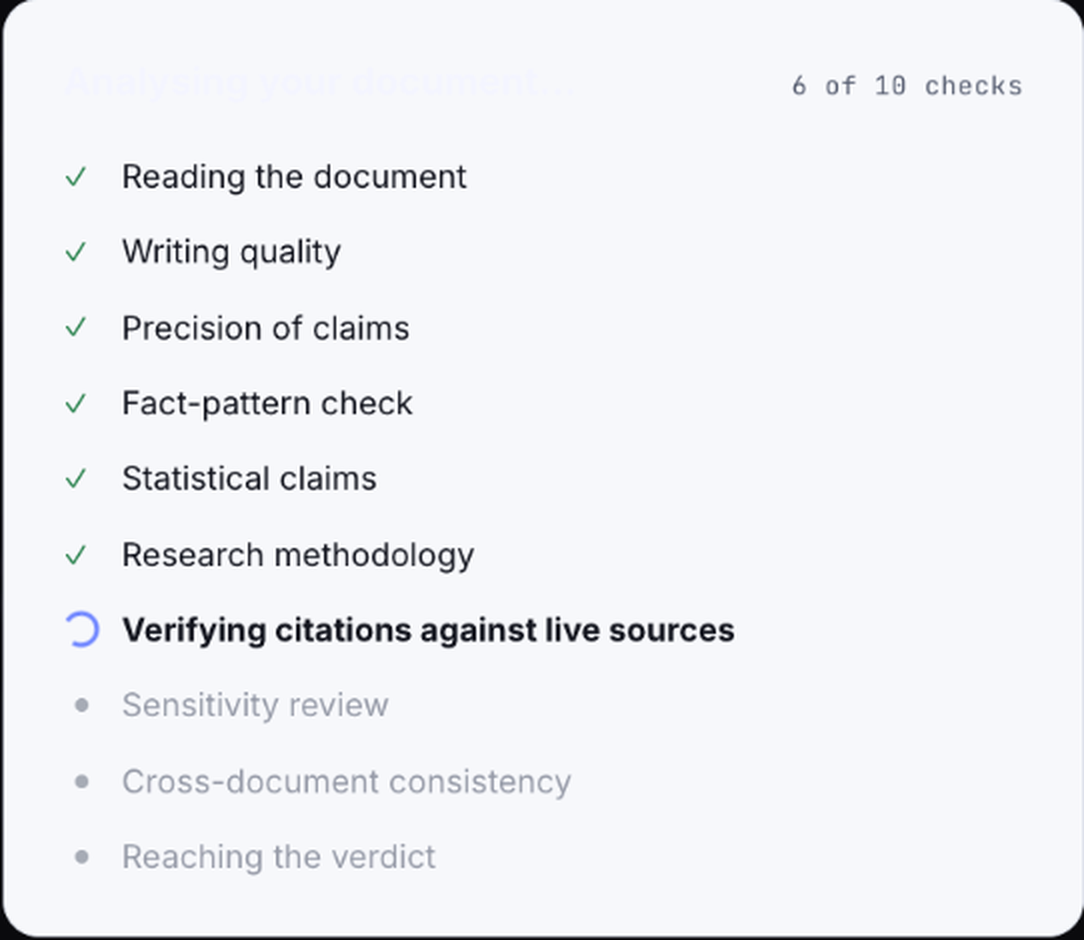
If a file you download does not match, it is not the file this piece describes, and that, rather than our word for it, is what makes the findings here checkable. We ran it on 20 August 2026 at 01:04, at Tier 3, Ukweli Certify, the same setting we used for the withdrawn draft. Ukweli counted it at 3,839 words and returned Review before publishing. Of the eight checks it runs, seven returned findings and one (the check for a document asserting one fact in one place and the opposite in another) returned clean. That is the document against itself. The Rudin finding above is the document against a source it cites, and the usage and spelling slips are a third thing again; each is a different check.
Word counts differ depending on how the text is pulled out of a PDF, so here are ours. Three common methods give 3,798, 3,806 and 3,787 words. A fourth, the bounding-box extraction used for the word-box count above, gives 3,820 word boxes. Ukweli counted 3,839. Highest to lowest, that is under one and a half per cent apart, which is ordinary, and shows nothing odd about the file.
An earlier 24-page August 2024 version of the framework also circulates, and copies of it are mirrored on other websites. The one we read is hosted by the law firm Fairbridges Wertheim Becker Attorneys, and is in the Sources list below. Its own cover carries no date; "August 2024" is the department's own description of it, given in the 2026 draft: "the South Africa National Artificial Intelligence Policy Framework of August 2024". Every finding here was established against the October edition and then re-checked against the August one. All of them appear in both: the quoted sentences, the contents-page gap, and a reference list identical character for character. The two versions differ in six places. The cover; the call for comments added to page 3, with its deadline and two paragraphs of guidance; the comment addresses repeated on the back cover; the removal of "(GPT)"; four blank notes pages; and the spelling of programmes. Nothing else changed.
We also put the August edition through Ukweli as a separate document, on the same setting, on 20 August 2026 at 22:37. It came back Review before publishing. Its summary independently names the same principal faults. The equality inversion, described again as a high-severity error inverting the NDP's stated goal; the orphaned claims; the misidentified edition of Russell & Norvig; and a reference list carrying a likely predatory journal. It also names, in the tool's own words, that "the Futures Triangle framework used throughout Section 5 is never linked in-text to its cited author." Two editions, analysed separately, returning the same findings.
The evidence about the reference list is the same in both files. Each contains exactly 37 clickable links (22 on the contents page, and the reference web addresses on the references page) and none anywhere else. Neither contains a single small raised number of the kind used to mark a footnote.
We have not published a total count of problems found. That number moves depending on how a document is divided up for reading, so it describes the reading rather than the document, and any total is only as good as its weakest item. A checking tool that publishes a figure it has not gone through one by one is doing the very thing it sells against. The twelve-reference figure is a different kind of number, for the reason given above.
Every specific finding quoted here was checked against the source PDF itself, not just against the tool's stored results. The quoted sentences were read straight off the department's file. All twelve references were verified against the publications they name.
Figures are frozen at the date above.
Sources #
- National AI Policy Framework, October 2024 edition, Department of Communications and Digital Technologies — dcdt.gov.za · archived 20 July 2026
- National AI Policy Framework, August 2024 edition (24 pages), as mirrored by Fairbridges Wertheim Becker Attorneys — fairbridges.co.za
- From the Government Gazette and media statements, Parliamentary Monitoring Group, 18 November 2024 — pmg.org.za
- UN Chronicle, Jeongki Lim, "Generative Artificial Intelligence: What It Is, What It Is Not and What It Can Be for the United Nations", 18 July 2023 — un.org
- Beall's List of standalone predatory journals (anonymously maintained successor to Jeffrey Beall's original, discontinued 2017) — beallslist.net · archived 20 August 2026
- Directory of Open Access Journals, ISSN 2394-3696 — no record — doaj.org
- IJIERT homepage — ijiert.org · archived 19 August 2026
- OECD artificial intelligence subject page — oecd.org · archived 19 August 2026
- Artificial Intelligence: A Modern Approach, editions and publishers from the authors' own site — aima.cs.berkeley.edu/translations.html (Fourth Edition 2020, Pearson; Third Edition 2009, Prentice Hall). The “© 2021, 2010, 2003” line quoted above is printed on the fourth edition's own copyright page.
- A Future That Works: Automation, Employment, and Productivity, McKinsey Global Institute, January 2017 — mckinsey.com
- Artificial Intelligence in the Public Sector: Summary Note, World Bank, 2021 — documents.worldbank.org
- Summary Report and Recommendations, Presidential Commission on the Fourth Industrial Revolution, Government Gazette 43834, GN 591, 23 October 2020 — gov.za
- Inayatullah, S., "The Futures Triangle: Origins and Iterations", World Futures Review 15(2-4), 112–121 (2023) — doi.org
- El Hadi, M. M., "Artificial Intelligence Background, Definitions, Challenges and Benefits" (the PDF the framework links to) — jstc.journals.ekb.eg · archived 19 September 2024
- Rudin, C., "Stop Explaining Black Box Machine Learning Models for High Stakes Decisions and Use Interpretable Models Instead", Nature Machine Intelligence 1, 206–215 (2019) — doi.org
- Kostin, K. B., "Foresight of the Global Digital Trends", Strategic Management 23(1), 11–19 (2018) — doi.org
- Naidoo, K., "Innovation, Digital Platform Technologies and Employment: An Overview of Key Issues and Emerging Trends in South Africa", SCIS Working Paper Number 9, University of the Witwatersrand, 2020 — wiredspace.wits.ac.za
- Emile Ormond, "SA's AI policy: A small step forward, but gaps remain", Daily Maverick, 4 September 2024 — dailymaverick.co.za
- Malatsi stakes South Africa's AI future on staying neutral, TechCentral, 5 August 2026 — techcentral.co.za
Integrity Watch is a verified register, neutral by design. Every entry is confirmed against a reputable source, and if it cannot be confirmed, it is not listed. Ukweli is a content integrity platform built by The Orkestra.
Get the next folio
One email a month from Integrity Watch: the new folio, and what changed in the register since the last one. Nothing else, and you can leave at any time.
The register itself stays free and public, and the full dataset is yours to download whether you subscribe or not.
Know the truth before you publish.
Ukweli checks documents for fabricated and unverifiable citations, sources, quotes and claims, before they leave your hands.